The Brewer Who Lets the Air Make the Sake: Inside Miyoshino Jozo's Ancient Mizumoto Method
Deep in Japan's Yoshino mountains, Teruaki Hashimoto revives a 15th-century brewing method that almost vanished from the world — and pushes it further than anyone else dares.
A Brewery Born From the Mountain
Follow the Yoshino River deep into the mountains of Nara Prefecture and you'll find a small brewery wreathed in cedar and mist. Miyoshino Jozo sits in one of Japan's most storied landscapes — a region famous for its thousands of cherry trees climbing the sacred slopes of Mount Yoshino, and long revered as a cradle of Japanese culture and Buddhist practice. Steam rises from the kura on cool mornings. The sound of the river runs beneath everything.
This is where Teruaki Hashimoto makes sake the old way. And then pushes it further.
Established in 1912, Miyoshino Jozo carries on the name "Hanatomoe" from a sake brewery that once stood on Mount Yoshino itself, until it was lost to fire. The current brewery — small, intimate, steeped in its surroundings — is the fourth-generation home of the Hashimoto family. Its water comes from a well named Yuzuruha no Ido, believed to be mentioned in one of Japan's most ancient manuscripts, the Man'yōshū.
A Brewer Shaped by Unlearning
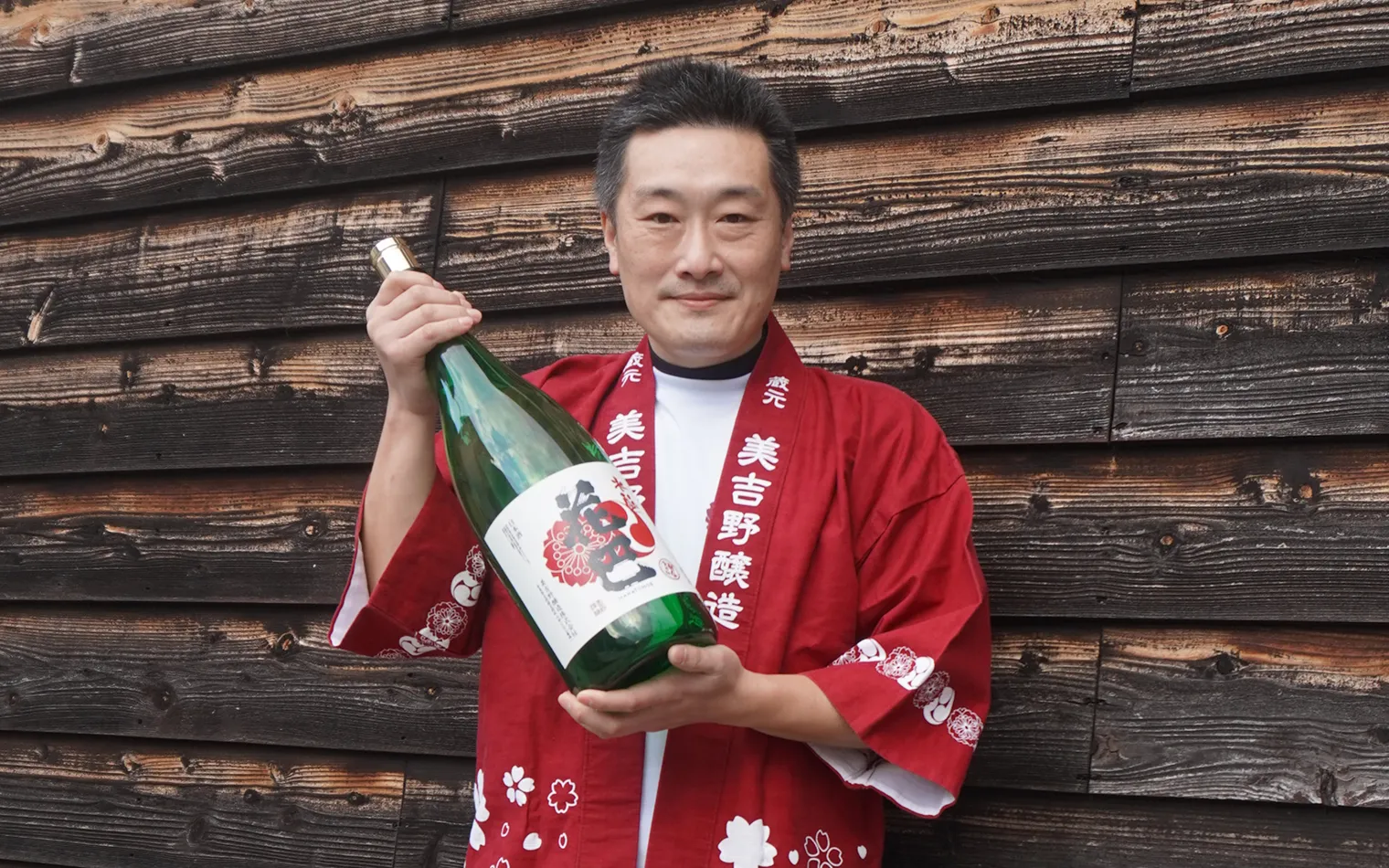
Teruaki Hashimoto did not arrive at his philosophy through tradition alone. After studying brewing at Tokyo University of Agriculture — Japan's foremost academic institution for the craft — he trained for three years at Kenbishi, one of Japan's oldest and most respected sake houses in the Nada region. It was there that he first encountered the idea of guiding microbes rather than controlling them. The experience, he has said, required him to unlearn much of what university had taught him.
He returned home to Yoshino and became Toji (master brewer) in 2009. What he found in the Yoshino valley changed his direction permanently.
Working alongside local rice farmers and forestry workers, Hashimoto had an encounter that reframed his entire understanding of quality. When he showed local farmers a rice polished down to 50% — the daiginjo standard — they called it wasteful. The gap between a brewer's definition of premium and a farmer's understanding of labour and land was stark. That moment reshaped Miyoshino's identity.
Today, Hashimoto keeps his rice at around 70% polish and focuses instead on completely dissolving it during fermentation — drawing out every molecule of umami and acidity the grain has to offer. He does not specify rice varieties on his labels, an unusual choice in a world where cultivars like Yamada Nishiki are treated like grand cru appellations. Instead, he works with approximately ten contract farmers in Nara, accepting whatever variety they grow and adjusting his technique to meet it.
"We truly are one in the same spirit with the rice farmers," Hashimoto has said. His sake is an act of agricultural solidarity as much as craft.
The Air That Makes the Sake
Hashimoto's brewing philosophy rests on a single, striking belief: the air makes the sake. At Miyoshino, roughly 60% of production uses no added commercial yeast and no temperature control. Fermentation tanks sit at ambient temperature year-round — near freezing in Yoshino winters, above 30°C in summer. Most brewers would consider these conditions a liability. Hashimoto considers them the point.
Wild yeasts, he argues, are the most honest representation of a place. They survive where cultivated yeasts cannot. They carry the identity of the local environment in every compound they produce. The acids they emit — layered, complex, sometimes funky — cannot be manufactured or replicated elsewhere.
This is the terroir of sake, expressed not through a grape that grows in soil, but through invisible microorganisms that drift in on mountain air.
What Is Mizumoto — and Why Does It Matter?
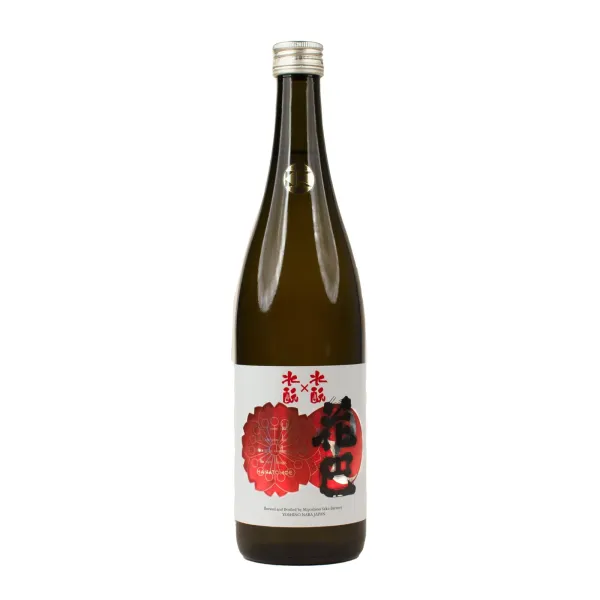
To understand Hanatomoe Mizumoto x Mizumoto, you need to understand bodai-moto — one of the oldest fermentation starter methods in the history of sake.
Bodai-moto was developed at Bodaisan Shoryakuji Temple in Nara during the Muromachi Period (1336–1573), making it a genuine medieval brewing technique. The method involves submerging raw polished rice and a small amount of cooked rice in water, then allowing natural lactic acid bacteria to acidify the liquid over three to ten days. This acidic water — called soyashi mizu — creates an environment hostile to spoilage bacteria but ideal for strong, wild yeast to thrive. Once sour, the raw rice is removed, steamed, and returned to the liquid. Koji is added, and the starter — the moto — completes over the following week or two.
The technique disappeared from mainstream brewing for centuries, eventually revived through research collaborations between Nara's brewers, Shoryakuji Temple, and regional food scientists. Miyoshino Jozo once sourced its starter from the temple itself. Now, Hashimoto makes his own soyashi mizu on-site — a version sometimes called mizumoto — relying entirely on the indigenous bacteria and wild yeasts of the Yoshino valley.
What makes the Mizumoto x Mizumoto exceptional — and, as far as anyone knows, unique in the world of sake — is a second step no other producer has taken. Hashimoto fortifies a completed batch of mizumoto with another batch of mizumoto starter. The sake is effectively brewed with sake. This is the meaning of the name: mizumoto squared.
What's in the Glass
The result is a Junmai Genshu (undiluted), Muroka (unfiltered), Namazake (unpasteurized) sake with an SMV of -10 and 18% alcohol — bold, dense, and alive. The double mizumoto process amplifies everything: richness, texture, acidity, and the deep honeyed sweetness that natural lactic fermentation produces.
On the palate, expect pronounced notes of honey and ripe pineapple, a luxurious full-body, and layers of complexity that unfold slowly. The finish is long. The sweetness registers at the top of the scale for sake, rivalling the intensity of a Canadian Ice Wine — making it a natural partner for caramel desserts, vanilla, or any dish that welcomes a rich, acidic counterpoint.
This is a sake for those who seek beverages shaped by place, by time, and by the courage to leave most of the decisions to nature.
"Most of our sake is brewed without yeast additives and are not temperature controlled. For this reason, it is necessary for people and the climate to come together to brew the sake — and that is where the unique value lies." — Teruaki Hashimoto, Toji, Miyoshino Jozo