Japan's Best-Kept Secret in a Glass
Discover Grace Wine's Koshu from Katsunuma, Yamanashi — a century-old family estate crafting Japan's most awarded indigenous white wine with quiet, arresting elegance.
Where Mountains Meet the Vine
Drive west from Tokyo for ninety minutes and the city dissolves. The Kofu Basin opens before you, rimmed by peaks in every direction — the Southern Alps to the west, the volcanic silhouette of Mount Fuji to the south, Mount Yatsugatake standing sentinel to the north. Nestled into the hillsides of Katsunuma, the air shifts to something mineral and clean. In the vineyards, clusters of pale, pink-skinned grapes hang in orderly rows, each bunch sheltered beneath a small paper umbrella — a sight that is quietly, unmistakably Japanese. This is the terroir of Koshu, and this is where Grace Wine has been making its mark for over a century.
Japanese wine remains one of the world's most fascinating undiscovered stories. While the country's sake culture commands global reverence, its vinous tradition runs equally deep — yet has only recently begun to earn the international recognition it deserves. Yamanashi Prefecture, Japan's premier wine-producing region, sits at the heart of that story, and Grace Wine sits at the heart of Yamanashi.
A Family. A Century. A Grape.
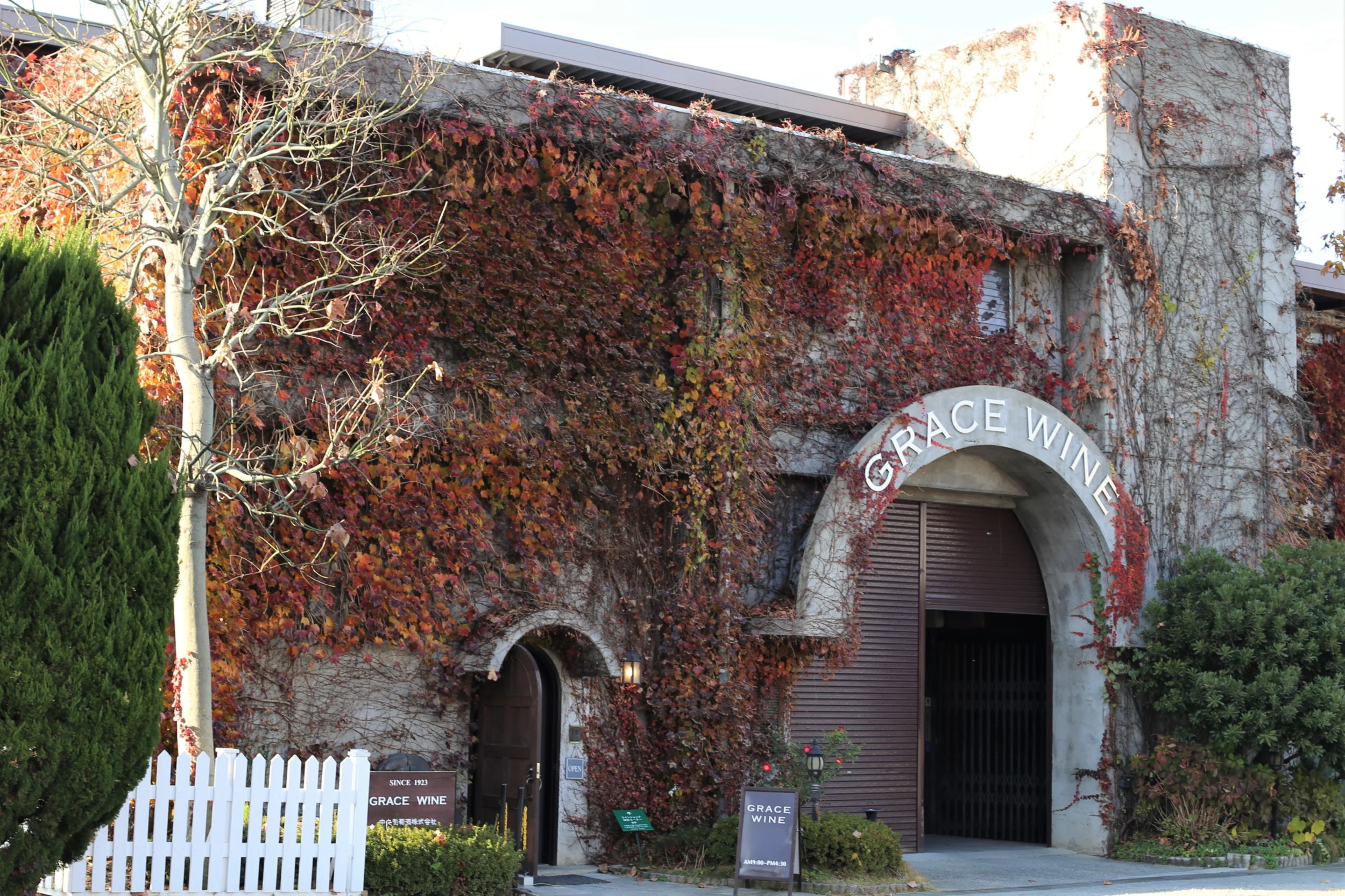
In 1923 — the same year as the devastating Great Kanto Earthquake — founder Chotaro Misawa established his winery in the hillside town of Katsunuma, in the prefecture of Yamanashi. The name Grace, drawn from the Three Graces of Greek mythology, came later, bestowed by third-generation owner Kazuo Misawa in the 1950s as the family redefined their ambitions and built underground cellars that still serve the estate today.
Five generations on, the Misawa family remains the unbroken thread running through every bottle. Fourth-generation president Shigekazu Misawa was the first in the region to trial Vertical Shoot Positioning (VSP) on Koshu vines in the 1990s, moving decisively away from the traditional pergola system to better manage vigour and concentrate flavour. In 2009, he chaired the founding of Koshu of Japan, a coalition of 15 Yamanashi wineries dedicated to bringing the grape to global markets.
Then came Ayana. In 2008, Shigekazu's daughter joined as head of viticulture and winemaking — the first woman to lead this century-old estate. Trained under Professor Denis Dubourdieu at the University of Bordeaux, certified at Stellenbosch University, and hardened by harvests across New Zealand, Chile, Argentina, and Australia, Ayana Misawa returned to Katsunuma carrying both a world education and a singular conviction: that Koshu deserved to stand among the world's great white grapes. Under her watch, in 2014, the Cuvée Misawa Akeno Koshu 2013 became the first Japanese wine to win a Gold Medal at the Decanter World Wine Awards — a moment that reframed the conversation about Japanese wine entirely.
Terroir Written in Stone and Sky
Katsunuma's genius lies in its geography. Ringed by high peaks that act as a natural shield against rain and typhoon, it receives far less moisture than most of Japan, producing well-drained, gravelly soils ideal for viticulture. The hilly viticultural zones — Toriibira and Hishiyama — sit between 400 and 600 metres above sea level, with complex topography, scattered granite formations, and clay-based soils that lend the wines their characteristic acidity and structural precision.
The Koshu grape itself is one of viticulture's great enigmas. Believed to have arrived in Japan along the Silk Road from the Caucasus around the 12th century, it is a naturally occurring hybrid of European Vitis vinifera and East Asian vine species. For centuries it was prized as a table grape; it was only in 2010 that it became the first variety indigenous to Japan to be registered with the International Organisation of Vine and Wine (OIV), granting it recognition as a legitimate wine grape on the world stage.
Grace Wine grows without herbicides or chemical fertilisers across its Katsunuma sites. Harvesting is done entirely by hand, with exacting bunch selection at every pass. The winery also became the first in Japan to employ indigenous yeasts sourced not just from grape skins, but from the soils and flowers of their own vineyards — a practice that anchors the wine's identity firmly to place.
Grace Koshu 2021: Transparency in a Bottle
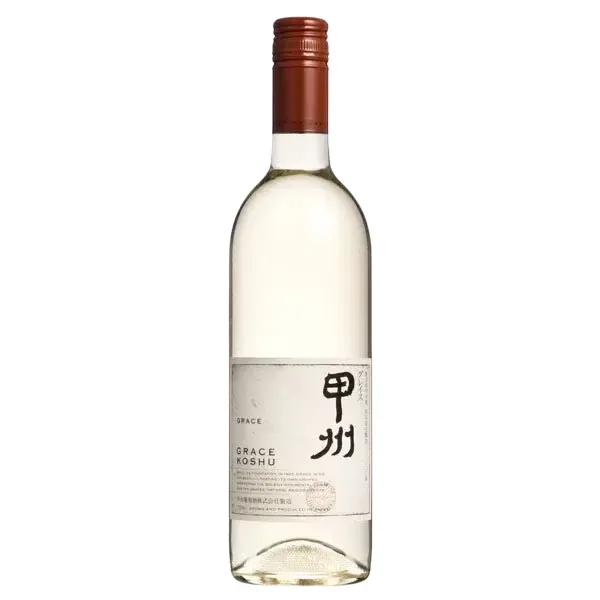
The Grace Koshu — label designed by Japan's celebrated graphic designer Kenya Hara — is the wine that introduced Koshu to the world. Featured in the World Atlas of Wine, praised by Jancis Robinson MW as a representative Japanese wine, and the recipient of multiple consecutive Gold Medals at the Decanter World Wine Awards, it is a benchmark by any measure.
The 2021 vintage, sourced from vineyards above 400 metres in the Katsunuma GI, is a study in precision and restraint. On the nose, fresh Japanese citrus — yuzu, sudachi — mingles with white flowers and a delicate thread of lemongrass. The palate is dry and crisp, light-bodied at 11% alcohol, with a softness that gives way to lively, focused acidity and a distinctive finish of white pepper that lingers with quiet authority.
This is what the Japanese mean by tōmei-kan — transparency. The wine does not announce itself loudly. It arrives like the landscape it comes from: measured, considered, and, once encountered, deeply memorable.
"The winery strives to bring out the full potential of the grapes nurtured in the vineyards." — Grace Wine
For the wine lover who has not yet discovered Japan, Grace Koshu is precisely where to begin.