BLÅ: How a Sommelier's Impasse in Copenhagen Sparked a New Era of Fine Dining Drinks
Copenhagen Sparkling Tea Company's BLÅ reimagines what belongs on the fine dining table — a masterfully blended, alcohol-free sparkling tea born from Nordic ingenuity and ancient Asian tradition.
A City That Demands Something Better
Copenhagen is not a city that tolerates mediocrity at the table. It is the home of hygge, of New Nordic cuisine, of restaurants that treat every dish as an act of philosophy. It is also, fittingly, the city where a single missing wine pairing changed the course of non-alcoholic beverages forever.
The story begins not in a laboratory or a boardroom, but in the dining room of a Michelin-starred restaurant, where award-winning sommelier Jacob Kocemba found himself facing what any sommelier dreads: a dish without a match. Despite standing before a wine cellar of more than 1,700 bottles, not one felt right for the evening's dessert. Rather than compromise, Kocemba turned to the tea shelf — and built something entirely new.
The Birth of a Category
What began as a homemade tea extract, a blend of carefully selected exclusive teas improvised in a professional kitchen, quickly became one of the restaurant's most talked-about offerings. Guests loved it. Kocemba kept refining it. Through hundreds of trials and an instinctive ability to layer flavour, he developed the exquisite combinations that would become the foundation of an entirely new beverage category.
In 2017, to realise the larger ambition of bringing Sparkling Tea to the world, Kocemba partnered with Bo Sten Hansen — a business strategist with deep roots in gastronomy. Together, they founded the Copenhagen Sparkling Tea Company, and on the 26th of May that year, the first bottle was sold in Copenhagen. BLÅ — the Danish word for blue — was among those first expressions.
Since then, the company has grown at a pace that speaks to how ready the world was for this idea. Today, Copenhagen Sparkling Tea is available in more than 50 countries and poured in over 100 Michelin-starred restaurants worldwide.
Nordic Precision, Asian Soul
The philosophy behind Copenhagen Sparkling Tea sits at an elegant crossroads: Nordic precision applied to Asian tea tradition. Jacob and Bo describe their approach as one of obsessive detail — each tea selected not merely for its individual character, but for the specific role it will play within a larger composition.
The process is resolutely hands-on. Every batch is hand-brewed by the founders themselves, a practice that is as much a labour of love as it is one of exactitude. Each tea within a blend is brewed at a different temperature and for a different duration, a method that allows each variety to express its most precise qualities before the components are unified in the bottle.
After blending, the teas are rested for two to three months — a patient, deliberate step that allows the blend to integrate and mature. Only then is the final touch added: a small base of grape must and a dash of fresh lemon juice, along with careful carbonation, calibrated to a refined 5 to 5.5 bars of pressure to ensure the bubbles are delicate and purposeful rather than aggressive.
The result is not tea dressed up to look like something else. It is a new thing entirely.
BLÅ: The Blend
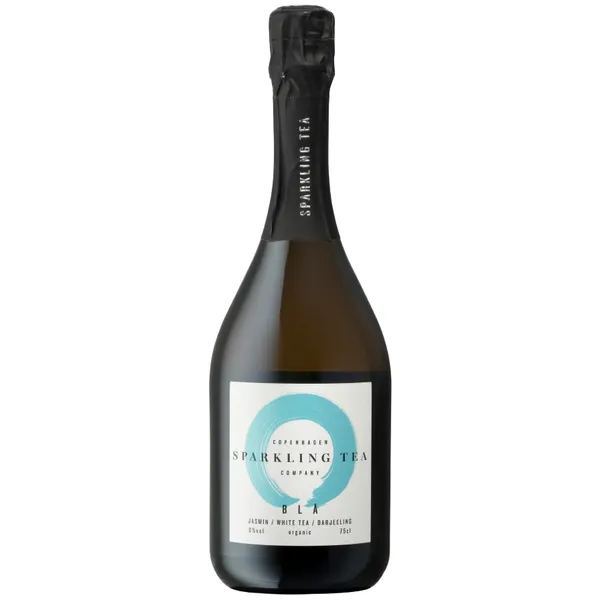
BLÅ is built around 13 organic teas, sourced from some of the world's most respected growing regions. At its aromatic core is jasmine tea — one of the oldest and most revered tea aromas in the world, grown at altitude in China, where fresh jasmine blossoms are picked in the early morning and layered with green tea leaves so that their fragrance infuses slowly and completely. The process is repeated multiple times, demanding the kind of patience that only the best tea masters observe.
White teas deliver roundness and a silken mid-palate; green teas add depth, complexity, and a gentle umami quality that gives the blend its structure. Then comes the Darjeeling First Flush — harvested by hand from estates in the foothills of the Himalayas, often called the Champagne of teas — which lends BLÅ its long, elegant finish and a set of comfortable tannins that feel quietly extraordinary for a drink with no alcohol whatsoever.
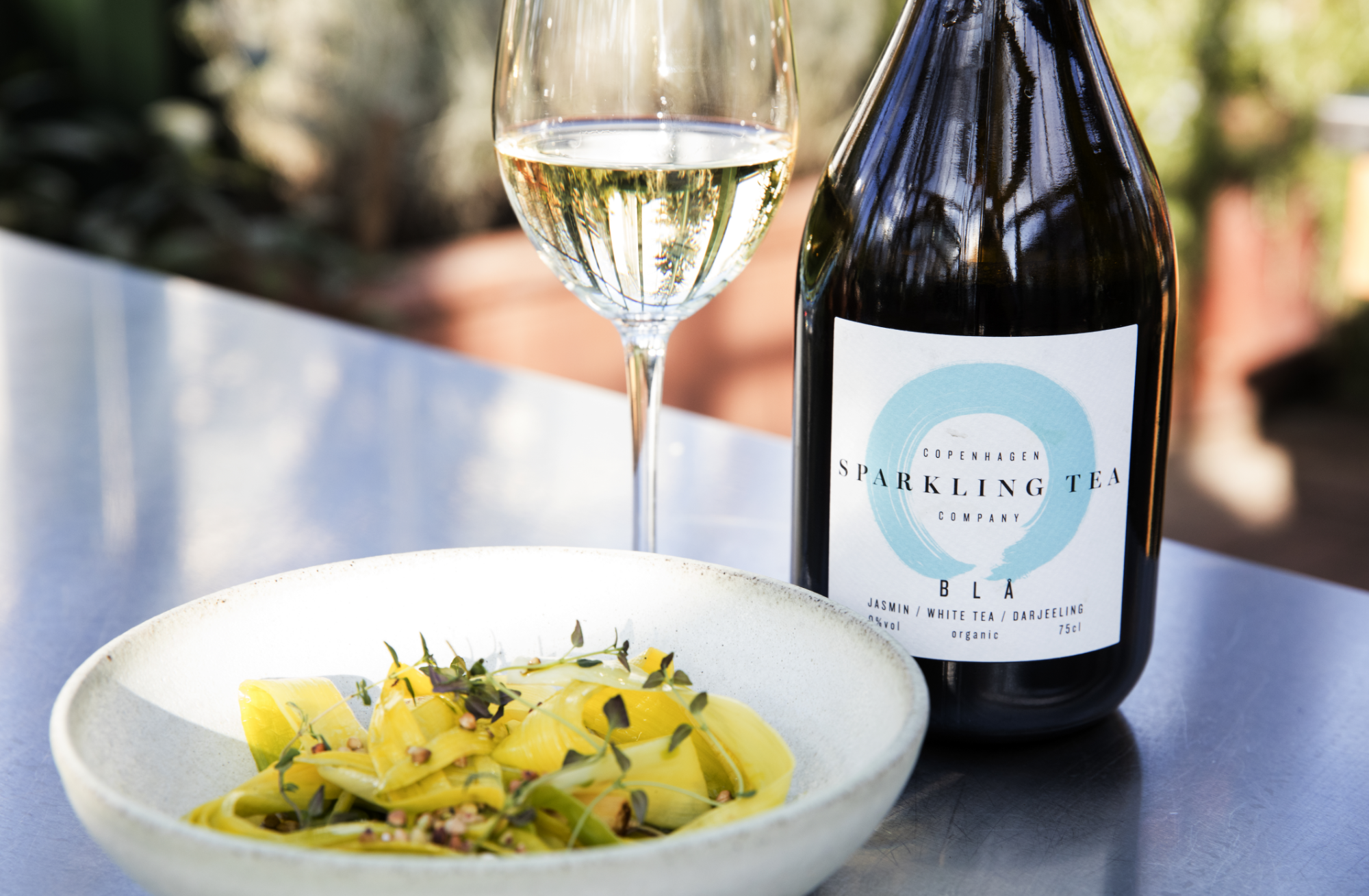
In the glass, BLÅ presents a soft pale green with golden-yellow nuances. The nose opens with jasmine and chamomile, with a whisper of citrus threading through. The palate follows with that characteristic roundness before the Darjeeling brings the experience to a measured, graceful close.
At the Table
BLÅ was conceived by a sommelier, and it shows. It is designed to work with food — not around it, not despite it. As an aperitif, it readies the palate without overwhelming it. At the table, it moves through a menu with the versatility of a well-chosen white wine: grilled meats, roasted vegetables, a plate of pasta, or a composed vegetarian main all find a willing partner in BLÅ's floral structure and anchoring tannins.
The philosophy here is inclusion. Not everyone at the table drinks alcohol, and they should never have to feel it. Jacob Kocemba built BLÅ for that guest — and, equally, for anyone who simply wants something beautiful and thoughtfully made in their glass.
That is, ultimately, what Copenhagen Sparkling Tea Company offers: not an alternative, but an answer. BLÅ is not trying to be wine. It is something rarer — an original.